


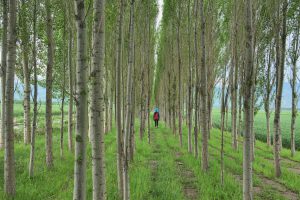
China’s tree-planting movement continues down a worrying path. The planting of artificial, single-species forests has not abated in China; in fact, it has worsened. The country’s original distribution of trees: fir trees in the south, poplars in the north, has made way for poplars everywhere – north, south, east and west. There are even attempts to start poplar plantations on the southern tropical island of Hainan.
The sides of motorways and railways across the country are flanked by poplars, most of which are artificially-bred strains. Take a drive around east China’s Shandong province and you will see new forests of young poplars replacing a diverse range of local species. When I was a child, Shandong was home to dozens of trees: from catalpas to sweet gum, oriental arborvitae, pagoda trees, elms, chinaberry, chestnut trees, walnut trees, honey locust trees and many more. But these seem to have all been replaced by the poplar almost overnight. When I graduated in 1985, local farmers first felled the trees that lined the province’s riverbanks; ever since they have only planted poplars.
Why are poplars such a common choice? Put simply, they are profitable. Poplars can be sold in the cities and increasingly in towns; the wood is shaved into two-millimetre thick boards that are used in high-density materials for fitting out buildings and constructing cheap furniture. This huge market has lead to an entire industrial chain planting, felling, shipping, processing and selling poplars. One northern city has several hundred wood processing plants alone. Wood processing is a polluting industry, which releases toxic chemicals due to the glues that are used. These can also harm – or even kill – workers who are regularly exposed to them.
Rising demand means rising prices, and poplars can fetch 1,300 to 1,400 yuan (around US$180 to US$190) per cubic metre – not far from the 1,700 or 1,800 yuan (US$234 to US$247) cost of highly sought-after woods such as Chinese catalpa and Chinese toon. These woods cannot be made into such thin boards, however, and do not have as wide a range of uses, hence the wide-scale planting of poplars.
Many will ask why we should not cultivate this fast-growing tree. It has a wide range of uses, after all. However, a quick-growing tree does not mean long-lasting wood. The artificial boards that poplar is used for only last five or six years. They are cheap enough to be thrown away and replaced as China frantically remodels its homes and offices. As a result, we are rapidly exhausting our non-renewable materials, including sand, concrete, bricks, plaster and stone. The short life-span of poplar products mean they do not fix carbon dioxide from the atmosphere for any significant length of time, unlike furniture or building materials made with quality woods, which can last a century or more.
High-density, single-species forests are a source of almost never-ending problems. Some even call them “green deserts” since they are very poor at retaining soil or water, unproductive and monocultural. China has the largest area of artificial forests in the world, but ranks last in terms of these forests’ productivity. These single-species require the constant use of fertilisers and other chemicals. They are weak ecosystems that are vulnerable to disease and pests, which can devastate large areas. They are also unattractive; artificial forests in scenic areas and along roads and railways are nothing to look at.
European countries, including France and Italy, planted similar fast-growing poplar and cedar forests after the Second World War to produce lumber. These plantations have largely disappeared with no harmful consequences. Even at their peak, Italy’s poplar plantations were limited to the plains of the Po River and accounted for 2.5% of the country’s forests. Today, 98.6% of Italy’s forests are in a natural or semi-natural state.
Japan started its shift from artificial to natural forests three decades ago. Lately it has gone further, moving towards selective felling, multiple-use forestry and the protection of natural forests. This improves the quality of Japan’s forests and ensures their long-term and multi-functional use. China can learn from this example.
In other countries, it is hard to find artificial forests with trees lined up in rows outside of strictly commercial forestry such as fruit growing. But it is easy to find these forests in China, where the trees appear like soldiers on parade, rather than arranged in any natural order. This shows our lack of consideration for the needs of forest ecosystems.
The Chinese government should consider the needs of local species and biodiversity. We need to consider planting slow-growth but high-quality wood alongside faster-growing species. We must reduce the dominance of the poplar, allowing natural forest ecosystems to play the role they should.
Jiang Gaoming is a professor at the Chinese Academy of Sciences’ Institute of Botany. He is also vice secretary-general of the UNESCO China-MAB (Man and the Biosphere) Committee and a member of the UNESCO MAB Urban Group.