Tim Lenton is a professor of earth system science at the University of East Anglia, in the United Kingdom. At a recent scientific congress on climate change, Lenton chaired a session about climate-change tipping points. These can occur, he explained, when subtle temperature thresholds are passed, resulting in large-scale environmental destruction and accelerating climate change.
Scientists at the conference discussed how tipping points in specific regions could have negative impacts around the world. One example is the decline of Arctic sea-ice, which helps to keep polar regions cool, meaning that when it melts, the region heats up faster still. Another is the loss of the Amazon rainforest, which could cause greenhouse-gas concentrations in the atmosphere to increase significantly if the Amazon were to absorb less carbon dioxide, leading to faster temperature rise. Andreas Fischlin, a coordinating lead author of the Intergovernmental Panel on Climate Change report in 2007, warned that there was a significant risk of large-scale loss of biodiversity: even a small temperature change of between 1.5 and 2.5 degrees Celsius could place 30% of species at an increased risk of extinction. This risk would increase significantly were tipping points passed. Small differences in temperature, it seems, can have very large effects.
chinadialogue’s Tan Copsey spoke with him about the science of tipping points.
Tan Copsey: What is a tipping point?
Tim Lenton: Tipping points are when a small change makes a big difference. In terms of climate change, it is where a little extra change in temperature can make the difference between, say, preserving the Amazon rainforest or causing it to die back. When we talk about tipping elements, we mean the bits of the planet, like Amazonian rainforest, that might exhibit a tipping point this century.
TC: Are there historical precedents for tipping points, and when did they occur?
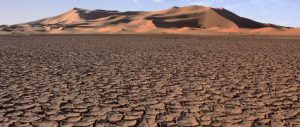
TL: There are a number of historical examples of the climate passing tipping points. Around 6,000 years ago, the Sahara was not a desert, but vegetated. Then, around 4,500 years ago, it very rapidly browned, turning it into a desert.
If you look a bit further back, into the last ice age, records of the climate for the Greenland show some very rapid warming events. These occurred twice as we came out of the last ice age, around 11,000 years ago and about 13,000 years ago. These were very rapid warmings, up to 10 degrees [Celsius] in Greenland, within the space of less than three to four years.
TC: What tipping points could occur, and when might they occur?
TL: Right now, we are mainly concerned about the decline of sea ice in the Arctic regions. The sea ice has been shrinking very rapidly in 2007 and 2008. The ice has also been thinning. In summer, the minimum, that is the day each year when the sea ice extent is at its lowest, is usually in September, but this is getting later and the minimum volume this summer dropped very sharply. I’m worried that might already be at a tipping point.
We are also concerned about the Greenland and west Antarctic ice sheets, which are both showing signs of shrinkage.
There are also a whole host of others that we think could be passed if business continues as usual and we see five or six degrees of global warming this century. In the tropics, we are concerned about the Amazon rainforest dying back, the stability of Indian and southeast Asian monsoons and vegetation in the Sahara. Towards higher altitudes, we are worried about losing the great boreal forests that cover much of Canada, Russia and Scandinavia.
TC: If we were to pass these tipping points, could we go back?
TL:It sometimes depends on the system. We talk about reversible and irreversible changes. The most worrying tipping points are in systems which have an inherent irreversibility, where even if you could turn the global temperature dial down, you wouldn’t necessarily recover the system. An ice sheet is like that because when you’ve melted it away, the altitude of the land is much lower and therefore warmer, so you have to cool things down an awful lot to recover it.
There’s some evidence that tropical monsoons or vegetation systems change might be a bit more reversible, at least in principle. The problem is that in practice we don’t expect the global temperature to come down very easily or regularly. Even if we stop emissions and stabilise greenhouse-gas levels, the temperature may be still steadily drifting up for several centuries. So reversibility in principle doesn’t mean anything will be reversed in practice.
TC: Are there any potential positive effects of tipping points?
TL: I think there could be. In the Sahara region there is some possibility that we can return to a more vegetated green Sahara state that we saw 6,000 years ago. This would require quite a profound reorganisation of the seasonal development of rains in that region, meaning it wouldn’t be good for everyone, but it could make that a better part of the world to grow food.
TC: How do you think the research on tipping points should impact policy? Should this change our timetables and emissions reduction targets?
TL: Firstly we welcome the prospect that work on tipping points would lead people to perceive climate change differently. Instead of thinking about climate change as some kind of smooth and largely predictable response of the earth to our activities, tipping points highlight the possibility that there are step-like changes in temperature and that one will never be able to predict the certainty where exactly they lie.
We have to think about climate change as a problem of risk management. We are really at a moment of gambling with the climate system.
So the objective, if you are trying to manage the risk, is to minimise the probability of passing tipping points – and that’s a strong argument for legislation to reduce greenhouse-gas emissions. It is also an argument for strengthening our ability to adapt.
This research probably also demonstrates why we need to think about other options that would go under the banner of geo-engineering. So, for instance, we could try to create artificial sinks for carbon dioxide. If we combine reducing carbon emissions with creating carbon sinks, we probably give ourselves the best capacity to stabilise and ultimately reduce greenhouse gases and temperature.
TC: What changes need to happen in wider society?
TL:We need social tipping points to avoid climate tipping points. If we are serious about weaning ourselves off carbon-intensive energy production and carbon-intensive lifestyles, social tipping points are good ways to achieve that. That has to range from changes in individual behaviour to collective changes. For instance, we need to change economic subsidy regimes so that they don’t encourage corporate fossil-fuel burning. Where there is fossil fuel burning, it should be recovered, captured and stored. Energy efficiency and the development of low carbon energy sources must also be encouraged.
Tan Copsey is development manager of chinadialogue
Homepage image from salendron