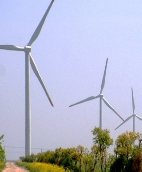


Wind power alone could provide electricity for all of China if the country overhauls its rural grids and raises the subsidy for wind energy, a new study finds.
China has rapidly become a global leader in wind energy and now ranks fourth in the world in installed capacity. But coal-fired power plants continue to supply most of the country’s rising electricity needs – a development path that scientists predict will lead to dangerous levels of climate change.
New models of China’s wind resources suggest that coal is not the only cost-effective energy option for the country. The winds blowing in China are powerful enough to generate low-carbon electricity that eliminates "much, if not all" of the power sector’s future greenhouse-gas emissions, according to researchers from Harvard University and Beijing’s Tsinghua University.
“We are trying to cut into the current defined demand for new electricity generation in China, which is roughly a gigawatt (GW) a week – or an enormous 50 GW per year,” said Michael McElroy, lead author of the study published in the current issue of Science, in a statement. “China is bringing on several coal-fired power plants a week. By publicising the opportunity for a different way to go we will hope to have a positive influence.”
As China’s demand for electricity increases an estimated 10% each year, the country is projected to need an additional 800 GW of coal-generated electricity during the next 20 years. With current wind energy payments of 0.4 yuan (US$0.059) per kilowatt-hour, wind energy could displace 23% of coal-generated electricity. If so, China would eliminate as much as 0.62 gigatonnes of annual carbon dioxide emissions, or 9.4% of the country’s current annual emissions, the study said.
Wind energy could supply all of China’s 2030 electricity demands, however, if wind contract prices were increased to 0.516 yuan (US$0.076) per kilowatt-hour, the study said.
“To determine the viability of wind-based energy for China, we established a location-based economic model, incorporating the bidding process, and calculated the energy cost based on geography,” said study co-author Xi Lu, a Harvard graduate student.
Rather than increase carbon dioxide emissions by 3.5 gigatonnes each year through 2030, as current policies would allow, the analysis determined that wind energy could replace 640 GW of coal-fired power. The switch would reduce emissions by 30% and require an investment of some 6 trillion yuan (US$900 billion).
“This is a large but not unreasonable investment, given the present size of the Chinese economy and the scale of the investments in both generating capacity and the grid infrastructure that will be required…to accommodate anticipated future growth in power demand," the authors wrote.
Extensive regions of northern and western China hold particularly large potential for wind energy, specifically the provinces of Inner Mongolia, Xinjiang, Gansu, and Tibet.
But the windiest areas are sparsely populated regions where electricity demands are low. High voltage transmissions lines are needed to connect these areas with electricity consumers in rapidly growing eastern China.
Meanwhile, existing wind farms are struggling to incorporate into the grid. Chinese law gives renewable power priority access to the grid, but a physical lack of grid capacity has limited wind energy’s ability to reach customers, according to the Global Wind Energy Council (GWEC).
Still, wind farms are expanding rapidly across China. The National Development and Reform Commission (NDRC), China’s top economic planner, set a 2010 wind energy target of 5 GW, which the country surpassed in 2007.
Wind energy supplied 12.2 GW of installed capacity last year, about 0.4% of China’s total electricity supply. China announced in May that more than 100 GW of wind energy capacity will be installed by 2020 and that renewable energy will supply 40% of the energy market by 2050.
The recent boost in wind production dates to the passage of a 2005 renewable energy law. The policy granted renewable energy providers with 10-year contracts and guaranteed subsidies. The NDRC clarified the renewable energy law in July by differentiating wind energy tariffs for various regions throughout the country.
In an effort to stimulate the domestic wind industry, the Chinese government also issued tax rebates last year for state-owned wind turbine manufacturers. Of the 70 Chinese manufacturers that produce wind turbines, more than 20 were formed last year, according to the GWEC.
Ben Block is a staff writer with the Worldwatch Institute. He can be reached at [email protected].
This article is a product of Eye on Earth, Worldwatch Institute’s online news service. For permission to reprint Eye on Earth content, please contact Juli Diamond at [email protected].
Homepage image from Greenpeace