Denmark has a special interest in climate change, in part because of its sense of responsibility – some would say guilt – towards Greenland, a Danish colony since the early 18th century. Although Greenland this summer took an important step towards independence, taking responsibility for judicial affairs, policing and natural resources, the Danish government must continue to fund the country’s social services, on which many of the citizens rely.
The Jakobshavn glacier is on Greenland’s west coast, where most of the country’s settlements lie. Though hardly lush, the west coast has patches of greenery where grasses and tiny Arctic flowers grow. Much of the east coast is even more inhospitable, with little more than ice and rocks. Near the settlement of Tasiilaq, on the east coast, I walked through a sheltered, snow-covered valley where, in the past, the Danes tried repeatedly to grow potatoes. They failed, and turned instead to converting the locals to Christianity, a more realistic goal.
Life for the Inuit communities, before air travel opened up the country and the cold war brought a little wealth in the form of air bases and listening posts, was so harsh it seems incredible that human beings could cling on here. Agriculture and livestock husbandry were out of the question, so Greenlanders subsisted on a diet of mainly fish and seals, and learnt to use every part of each creature. With no trees, they relied on driftwood to build their boats. Half the year was spent in darkness, mainly in communal turf houses dug into the thin soil, lit only by blubber lamps. With no means of softening the hides of the animals they killed, Inuit women chewed sealskins for much of the winter, their saliva curing the hides and readying them for use. Early visitors reported that the women’s teeth were worn down to the gums from an early age.
Little wonder that Greenlanders had no votive relationship with their gods. They had a creation myth, but did not bother to pray to the undersea goddess from whose hair mankind was combed. Why would they? It must have been self-evident that they were on their own.
Today, Greenland’s problems are of a different kind. This is a poor country, with high unemployment. People here feel that the Danish government has always treated them with disdain, only taking an interest when it seemed that Greenland’s mineral wealth might become accessible. There are high rates of alcoholism and other social problems. The children score poorly on school tests relative to their contemporaries in Denmark and there are limited prospects for the young.
Jimmy Hymøller, a schoolteacher, told us how he was trying to change things by encouraging parents to take a more active part in their children’s education, which many felt unable to do before. Most Danes you meet in Greenland have a similar sense of purpose – a new wave of secular missionaries bent on trying to reverse the mistakes of their forebears.
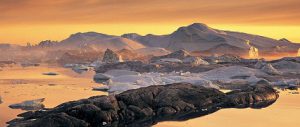
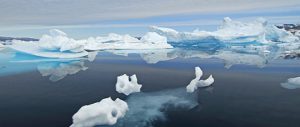
Lars Olsen, a fisherman, took our photographer, a local businessman called Tom Ostermann and me on his boat to where he fishes for halibut. The small craft crunched easily over the smaller lumps of ice – merely the size of household furniture – and wove a path deftly among the larger bergs. Danger precluded him from taking us near the really big ice closer to the glacier edge, the pieces that rose into the sky taller than office blocks.
Close up, the ice looks harmless and stable, stately as a galleon and twice the size. Bubbles rise to the surface in a steady stream from the nine-tenths of its bulk that is submerged. But in their voyage to the open sea, icebergs can turn over dozens of times, unpredictably, as the melting above and below the waterline suddenly shifts their centre of gravity. And floating beside an iceberg, it is impossible to judge whether an overhang is stable or riven with fissures that will suddenly sheer. “It’s wise not to get too near,” Ola Johannessen, the ice expert, warned me – though, later, I found out that he had a propensity for landing on bergs in helicopters.
In his 30 years as a fisherman in these waters, Olsen has seen his catches decline drastically. “I get fewer fish on my lines now – and the ones I do get are smaller,” he told us. He catches halibut by laying down several lines, many metres in length, with hooks every foot or so, and leaving them in place overnight. “I have to lay more lines and don’t get as much. And the price of the fish is not good.” He blames the reduced catches squarely on overfishing. “They should not allow so many fishermen. They should not give so many licences.” Would his children follow him into fishing? Certainly not, he replied. His son was an economist.
Inuit people, though, even those with town jobs in the schools, hospitals and fish factories, carry on fishing and hunting. Every house in the settlements has what look like washing lines on the roof, hung with drying fish. We met one teacher who had taken the children from his class to live on a small island for the summer, to teach them traditional skills such as catching and curing fish.
Hunting is the way of life for the Inuit, and staying in Greenland leaves little room for squeamishness. On the first night of my first visit, accompanied by Jacqueline McGlade from the European Environment Agency, we had a delicious soup with small squarish pieces I took for vegetables. No, our host explained, it was the skin of a narwhal, one of the rarest mammals in the world – the Inuit are allowed to hunt a certain number each year. Later, I ate whale steaks – tasty, with a rich gamey flavour. Seal was on the menu, too, and we visited a factory where the fur was stripped from baby seals, leaving holes where the flippers had been. These would become hats, slippers, waistcoats and scarves for sale in the airport shop.
Hunting, like fishing, is under threat. Hunters we met complained that the season was growing shorter as the ice had become treacherous. Whereas before, it froze firm enough all winter to take dogsleds and skidoos, now it has thinned and breaks up easily, making sledding impossible for months. Ice fishing has also become impossible for much of the winter in some traditional hunting grounds.
And then there’s the problem that some of the Greenlanders’ traditional quarry are rapidly dying out. At a small settlement near Tasiilaq, I saw a polar bear that had recently been killed along with its cub. The flayed skin was stretched out to dry on a wooden frame. It stank a little, with the last remnants of flesh and blood oozing on to the ground, but the fur was silky to the touch. The skin itself is black, to attract sunlight and keep the bear warm. But the claws were the most striking thing – more than 23 centimetres long, curved and deadly. It was easy to see why the Inuit call them Nanuk: mighty hunter worthy of respect.
There are only about 20,000 polar bears left in the world. Their number has declined as their habitat has shrunk. Polar bears hunt seals from ice floes, swimming between them. There have been reports of bears drowning – a previously unheard-of event – because the distance between floes on to which they can climb is too great. Some have probably starved. There is an increasing problem of bears straying into villages in search of food. Other Arctic mammals are also suffering. A US Geological Survey expedition in September spotted a large group of walrus carcasses, more than 100, on an Arctic shore. They were almost certainly corpses from a bigger group seen a few days earlier congregating on the ice. Examination of the carcasses, mostly calves and yearlings, indicated they had been trampled to death by other walruses, stampeding to find a place on the crowded shore.
Much though environmental groups would protest, the harsh truth is that human beings – even Greenlanders – can live without polar bears and walruses. Their demise would simply lengthen the long and ignoble list of species our kind has made extinct. Besides, Greenland’s ice will take a very long time to melt completely – a thousand years, according to the best estimates. The loss of the Greenlandic way of life long before this would also be mourned, but not by many. If this were merely an Arctic problem, politicians would not be visiting Ilulissat.
The real threat of climate change is not that the ice will melt (though when it does, we are in trouble because the departure of reflective ice leaves dark sea that absorbs more of the sun’s heat, increasing the rate of global warming in another feedback loop). The real disruptions of climate change will be felt far from here: in sub-Saharan Africa, where the heat will become unbearable; in south-east Asia, where rising sea levels will claim more and more land and typhoons will destroy towns and villages; in southern Europe, where drought will render the land unsuitable for agriculture.
The biggest threat of all is to the world’s social and political stability – the famines, droughts, floods and storms of a warming world could cause prolonged conflict, mass migration on a scale we shudder to imagine, and a counter-reaction to that migration from the lucky northern countries.
It’s just that Greenland, and the rest of the Arctic, are where we see the first and clearest signs of rapidly increasing temperatures and their effects on the natural world. Greenlanders, in fact, are often ambivalent about warming. In the south, a few people are successfully growing potatoes – a century after the Danes gave up – and even more surprising crops such as tomatoes. They are also raising cattle. In the in-flight magazine of Air Greenland, I couldn’t help but notice that global warming was referred to as “climate improvement”.
Greenlanders have been the world’s master survivors, stubbornly carving a life for thousands of years out of the most inhospitable desert on the planet. They have little to fear from warming. Tom Ostermann told us: “I have no concerns that the people of Greenland will survive and will be OK. We have always been able to adapt. We are more concerned about places like Holland, for when the sea level increases. It’s those places where people have to be worried.” He leaned forward in his boat, smiling mischievously, and added: “One up to the Eskimo.”
Fiona Harvey is the Financial Times environment correspondent
Copyright The Financial Times Limited 2009.
Homepage image by Ramon Stoppelenburg