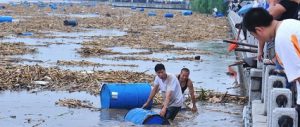
If one word could sum up China’s environmental events of the Year of the Tiger, it would be “leak”. At the beginning of 2010, a diesel leak from the Weinan branch of a China National Petroleum Corporation (CNPC) pipeline contaminated the Yellow River. On July 3, Zijin Mining leaked waste water into the Ting River. July 17 saw an oil pipeline in Dalian explode and pollute the surrounding ocean. And, on October 22, a smelting plant in Shaoguan, in south China, released 300 kilograms of thalium into the Bei River.
The global community was also in on the act: in June, the BP leak in the Gulf of Mexico became the year’s worst environmental disaster. All of these leaks can be traced back to major failings in management and supervision.
The companies concerned are, of course, directly responsible for these disasters. But pollution is rarely caused by just one incident – it is the result of a process. Only when pollution accumulates to a certain degree do its effects become visible. Although it sounds like the events listed above occurred suddenly, in fact they were all linked to management failures that had built up over time.
Zijin Mining for example has been polluting the Ting River for years, and this particular incident took place nine days before the company owned up to it. Its first reaction was not to inform the environmental authorities or take measures to stop the leak, but to impose a news blackout and organise a cover-up, making the actual situation even worse.
Most of the environmental accidents of 2010 involved state-owned energy and mining firms. It is clear that the management styles of these companies are out of date, their systems lack early warning signals and they have no concern for the public interest. In this sense, pollution in China is not merely a natural consequence of economic growth, but rather the result of a series of human errors.
The system of government supervision is also full of holes. During all of these events, the voice of the environmental authorities was notably weak – a reflection of their lack of strength in the wider system. (It is worth noting that the Ministry of Environmental Protection was a more active protector of the environment before being promoted from bureau status.) An overly close relationship between government and business has led both the executive and the judiciary to neglect their responsibilities when responding to such events. The compensation received by the farmers, fishermen and locals affected by the Zijin Mining and CNPC leaks has been insufficient to cover their losses.
Moreover, there has been no effort to deal with the root causes of the pollution. After the leak in Dalian, CNPC came up with the brainwave of “investment in lieu of compensation”, which meant building an even larger oil-storage facility in the area. Rarely do the responsible parties in these cases suffer proper sanctions, while government officials face neither criminal nor civil liability and the victims are left without satisfactory compensation. If environmental cases are not dealt with fairly, it will be impossible to avoid similar events in the future.
Taking a wider view, it is possible to see that institutional failings have allowed frequent environmental disasters to happen in China. For example, when the Institute of Environmental and Public Affairs (IPE) evaluated 113 Chinese cities for transparency on environmental pollution issues, many – including Beijing, Tianjin and Hangzhou – had either worsened, or failed to improve since the previous year. At times, journalists have been stopped from visiting the scene of a disaster in the immediate aftermath, and some have even been detained or beaten. Local governments refuse to publish facts promptly and restrict media reporting in the name of “maintaining stability”, greatly reducing the ability of the public to act as a supervising force.
But burying our heads in the sand is not going to resolve China’s environmental problems – as demonstrated by the events of 2010. According to the head of the Ministry of Environmental Protection’s Emergency Response Office, between January and July, the ministry received and dealt with reports of 119 environmental emergencies, an increase of 35.2% on 2009 statistics. News agency Bloomberg reported even more shocking figures: in the first half of 2010, it said China saw a 98% increase in reported environmental crises.
At the same time, the cost of environmental degradation over the 11th Five-Year Plan period increased from 511.8 billion yuan (US$77.7 billion) to 894.8 billion yuan (US$135.9 billion), up 74.8%, and equivalent to 3% of GDP. There was also an increase in the number of protests sparked by environmental problems, showing that, for all their talk of protecting stability, local governments are not achieving this through their restrictions on reporting.
Worryingly, despite the grave environmental outlook for China, no one is acknowledging these systemic problems. While failing to put their own houses in order, the authorities boast of their environmental achievements – and even try to shift the burden onto the public. This attitude is amply demonstrated by two government actions in the past year: first, cutting off power to companies to achieve energy-saving and emissions-reduction targets and, second, focusing on the public’s environmental duties – as opposed to the government’s own, or those of the business sector.
In the final month of 2010, the media focused on a piece of “good news”: the government’s achievement in hitting the year’s energy-saving and emissions-reduction targets, set out by the 11th Five-Year Plan. This was cause for both celebration and concern: naturally it is good news, but cutting off power to factories in order to meet an energy goal is simplistic, crude and unsustainable. It shows that the government can be hugely and immediately effective, but also that the business sector has not yet made energy-saving and emissions-reduction part of normal production practices.
Even leaving questions about the accuracy of the statistics to one side, there are still concerns: in the end even hospitals and homes had their electricity supply cut off, and both businesses and the public paid a price they should not have had to. Although the target was “met early”, it is obvious that this did not happen as the result of an effective, long-term plan – on the part of either government or business.
Meanwhile, public environmental education is, as always, entirely focused on getting the public to act responsibly. On June 5, World Environment Day, the slogan “low carbon, low emissions, green life” was used to encourage ordinary people to make changes in their own lives in order to cut pollution. This leaves me speechless: China’s pollution is created by poor management and the profits-first attitude of big business, yet it is to be solved by the public adopting “green lives”? This is not to say members of the public should not strive to fulfil their ecological responsibilities, but that, if China’s problems are ever to be solved, there must be effective ways of sanctioning those with the greatest responsibility for creating them.
Public participation must increase if we are to prevent further environmental disasters at the same time as maintaining economic growth; and learn how to cut emissions without also cutting power. The greatest responsibility the public has is not to change their own lives, but to supervise the behaviour of the largest polluters and the rigour of government enforcement. Public participation could prevent the same human errors from repeating themselves. But institutional barriers to public participation, through both NGOs and the media, remain in place.
The authorities may have tried to shift blame onto the public, but it was actually the public – or civil society – that was responsible for year’s environmental bright spots. In April, the IPE and 33 other Chinese NGOs published a report on heavy-metal pollution in IT supply chains, which called on 27 global technology companies to audit their suppliers. In May, Green Watershed and nine other Chinese campaign groups published a report on the environmental record of the country’s banking sector, advocating green lending policies and a reduction in loans to energy-hungry and dirty projects.
In July, NGOs sent open letters to the Shanghai and Hong Kong stock exchanges, asking them to expose Zijin Mining’s deliberate delay in publishing environmental information. Non-profit group Huai River Warrior provided rural residents along the river with biological water purifiers, while the Alishan Society of Entrepreneurs and Ecology launched a “Green Leadership” training course.
This list demonstrates the increasing maturity of non-governmental environmental forces in terms of both organisation and activities. The facts show that, where there is transparency, public participation is the best way to deal with corporate and governmental failings. The Chinese public is starting to participate on a large scale in environmental affairs that are closely related to their interests and health – through investigations and surveys and social activism, and by engaging in legislation, reporting pollution, attending public hearings and fighting for their rights. In doing this, the public is coming together to form a more active civil society. This is the Year of the Tiger’s real good news.
Tang Hao is an deputy professor at South China Normal University, a Fulbright scholar and columnist.
Homepage image from maven@china shows a beach in Dalian after the spill.