中国与世界,环境危机大家谈 WHERE CHINA AND THE WORLD DISCUSS THE ENVIRONMENT

每日星球 the daily planet

中外对话编辑们的专栏博客 the chinadialogue editors' blog

What's in China's 12th Five-Year Plan? Olivia Boyd | Mar 07

发表评论 0 comments 中文

It was an eventful weekend in Beijing, as premier Wen Jiabao set out key policy targets for the next five years to the 5,000 delegates gathered in the capital for the annual session of the National People’s Congress and Political Consultative Conference – the two bodies that determine national-level policy. (You can read his full report here.) 

The 12th Five-Year Plan, which covers the period 2011 to 2015, won’t be formally launched until the end of this week, but the headline figures for energy and climate are clear: a 16% cut in energy intensity; a 17% cut in carbon intensity; and a boost in use of non-fossil fuel energy sources to 11.4% of primary energy consumption (it is currently 8.3%). 

Beyond these numbers, what do we know about China’s new development blueprint so far? Below are some of the key points: 

- The plan is aiming for average annual GDP growth of 7% and is seeking what it terms “inclusive growth” – rebalancing the economy to spread the benefits more equally, as well as alleviating social inequality and protecting the environment. The government wants to create 45 million jobs in urban areas, keep registered urban unemployment below 5% and boost domestic consumption. 

- Investment in environmental protection is expected to step up to around 3 trillion yuan over the five-year period. Much of this will go on pollution control, with an aim to cut the release of major pollutants by 8% to 10%, and to reduce chemical-oxygen demand, sulphur dioxide, ammonia nitrogen and nitrogen oxide by 1.5% per year to 2015.   

- As part of its strategy to meet carbon-intensity and energy-intensity targets, China is aiming for “more efficient” nuclear-power development. It also plans to boost hydropower construction in the south-west and increase the length of its high-speed railway to 45,000 kilometres. 

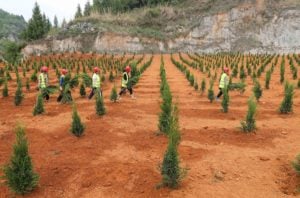
-  China’s forest coverage rate is targeted to rise to 21.66 percent and forest stock to increase by 600 million cubic metres. Meanwhile, annual grain-production capacity is  to be no less than 540 million tonnes and farmland reserves no less than 1.8 billion mu (around 1.2 million square kilometres). 

- Beijing will prioritise – with the aid of tax breaks and beneficial procurement policies – the development of seven “Strategic Emerging Industries” (SEIs): biotechnology; new energy; high-end equipment manufacturing; energy conservation and environmental protection; clean-energy vehicles; new materials and next-generation information technologies. It is thought these industries could contribute 8% of GDP by 2015, up from approximately 5% now.

- Two thirds of the central budget is to be invested in “improving people’s livelihood” in 2011. Over the FYP period, the government is aiming for a population no greater than 1.39 billion and to increase average life span by one year. Some 36 million apartments for low-income families will be built or renovated. And pension schemes are to cover all rural residents and 357 million urban residents. 

We’ll be adding to this list as more information comes out and running more in-depth analysis on specific aspects of the FYP over coming weeks. In the meantime, catch up on our coverage of energy-intensity targets here, and read analysis of the impact of China’s new targets on Europe here. And tell us what you think of China's new development plan.

关于作者 About the author(s)

奥利维亚•博伊德,中外对话助理编辑。

Olivia Boyd is assistant editor of chinadialogue.


参与讨论 Comments (评论数 Posts: 0)

订阅讨论内容 subscribe to discussion RSS RSS

Default_thumb_avatar

登录 Log in / 注册 Sign up
评论 to comment

发表评论 Post a comment

登录 Log in / 注册 Sign up 评论 to comment